 en

Restore facts with
objectivity, connect
the future with insight
Follow BSTABO Intelligence for more valuable information to know

Follow BSTABO Intelligence for more valuable information to know
Agricultural work often takes place on terrain that changes with the weather and season. Muddy fields, steep farm trails, loose gravel, and uneven ground can make routine transportation difficult. For farmers and land managers, choosing electric farm vehicles with suitable traction, ground clearance, and suspension is essential for maintaining mobility across demanding outdoor environments.
Unlike paved roads, agricultural routes rarely provide consistent grip. Wet soil can cause wheel slippage, while steep slopes require controlled power delivery and stable handling. An electric utility ATV designed for off-road farming can help operators navigate these conditions while supporting daily transportation, property maintenance, and equipment movement.
Traction is one of the most important considerations when selecting an electric ATV for muddy terrain. When the ground becomes slippery, distributing power across more wheels can improve the vehicle's ability to maintain forward movement. Selectable 2WD and 4WD allow operators to adapt the driving configuration to changing surface conditions.
Two-wheel drive may be suitable for relatively firm trails and routine transportation. Four-wheel drive can provide additional traction on muddy tracks, loose soil, and uneven slopes. For agricultural operations involving frequent changes in terrain, this flexibility helps make electric farm vehicles more versatile.
However, four-wheel drive does not eliminate the risk of getting stuck. Tire condition, vehicle loading, ground composition, and driving technique remain important factors. Operators should avoid sudden acceleration and excessive wheel spinning, particularly when crossing saturated soil.
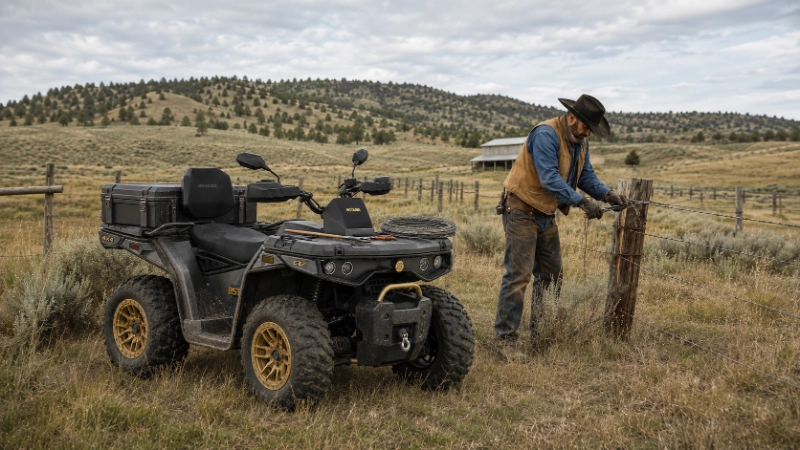
Ground clearance affects how effectively an ATV passes over rocks, ruts, roots, and other obstacles. A vehicle with sufficient clearance is less likely to make unwanted contact between its underside and the terrain, which can be particularly important when navigating narrow agricultural trails.
BSTABO's ROCK electric ATV features 300 mm of ground clearance, providing space for navigating uneven outdoor surfaces. Its independent suspension helps the wheels respond to variations in terrain, supporting stability and ride comfort during off-road operation.
On steep farm trails, maintaining a controlled speed is equally important. Operators should assess the slope, surface grip, and available turning space before proceeding. A suitable electric farm vehicle can support access to challenging areas, but safe operation still depends on terrain assessment and responsible driving.
Farm trails frequently contain potholes, compacted soil, loose stones, and uneven surfaces. Independent suspension allows each wheel to respond more effectively to changes in ground level, helping maintain contact with the terrain and reducing the impact of bumps transmitted to the operator.
BSTABO ROCK uses a double A-arm independent front suspension and a double A-arm independent rear suspension with a stabilizer bar. These components contribute to handling and stability when traveling across irregular ground.
Suspension performance should be considered alongside tire selection, vehicle weight, and load distribution. Excessive cargo or an unevenly distributed load can affect handling, particularly on slopes. For electric agricultural vehicles, maintaining the recommended load limits is important for predictable performance.
Electric power offers several practical advantages for agricultural transportation. Lower operating noise can be valuable when traveling through livestock areas, residential surroundings, or environmentally sensitive locations. The absence of tailpipe emissions during operation is another consideration for farms seeking to reduce local exhaust emissions.
Electric farm vehicles can support a range of tasks, including inspecting fields, transporting tools, maintaining fences, and accessing remote sections of a property. Their usefulness depends on the available battery capacity, terrain, operating temperature, cargo weight, and frequency of acceleration.
Battery range should therefore be evaluated according to actual working conditions rather than a single published figure. Mud, steep climbs, heavy loads, and frequent stops can increase energy consumption and reduce the distance available between charges.
| Feature | Practical Agricultural Benefit |
|---|---|
| Selectable 4WD | Helps improve traction on loose or slippery ground |
| 300 mm ground clearance | Provides space for uneven terrain and obstacles |
| Independent suspension | Supports wheel movement and ride stability |
| Electric powertrain | Reduces operating noise and local exhaust emissions |
| Agricultural accessories | Supports transportation and selected outdoor tasks |
| Battery charging capability | Helps plan vehicle use around working schedules |
The right electric farm vehicle depends on the type of work and the terrain involved. For properties with muddy access roads or steep trails, traction and ground clearance should receive particular attention. For larger farms, battery capacity and charging arrangements may have a greater influence on daily productivity.
Utility accessories can also expand the range of tasks an electric ATV performs. Cargo boxes can support the transportation of tools and supplies, while compatible towing accessories may assist with selected agricultural activities. Accessory compatibility and permitted loads should always be confirmed before operation.
BSTABO develops electric off-road vehicles for agricultural operations and outdoor use. Its ROCK electric ATV combines electric propulsion with off-road handling features, providing an option for users who need to travel across challenging farm terrain.
Electric farm vehicles equipped with appropriate tires and selectable four-wheel drive can be suitable for muddy agricultural terrain. Actual performance depends on soil conditions, traction, vehicle loading, and operator technique.
An electric ATV may handle suitable slopes when it has adequate traction, power, and ground clearance. Operators should follow the manufacturer's operating guidance and avoid slopes that exceed the vehicle's rated capability.
Four-wheel drive, ground clearance, suspension, battery capacity, load limits, and accessory compatibility are important considerations. The best combination depends on the terrain and the intended agricultural tasks.
BSTABO ROCK combines electric propulsion, selectable drive configurations on compatible versions, independent suspension, and practical accessory options. These features support transportation and outdoor mobility across a range of agricultural environments.
Give us your email and you will be daily updated with the latest events, in detail.


